How much caffeine is in matcha?
Two lab tests found 16 and 42 mg of caffeine per gram of matcha powder. A 2 gram serving has about 32 to 84 mg, and a strong one comes close to an 8 oz coffee, which has about 95 mg.
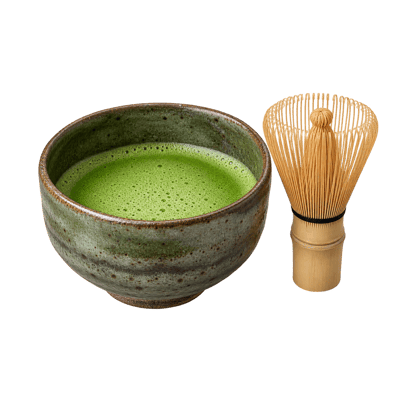
Matcha is green tea, and green tea is the mild one, about 29 mg in a brewed cup, so people treat matcha as a gentle afternoon drink. The difference is that with matcha you drink the leaf itself, ground into powder and whisked into water. With brewed green tea you drink only what the water pulls out of the leaves, and then the leaves go in the trash. It’s like eating the spinach instead of drinking the water it was cooked in.
We’d treat a big matcha like a coffee when you time it. A small, weak bowl at 4pm is fine. A latte made with 4 grams of strong powder comes close to a 16 oz coffee, and it belongs before lunch if coffee keeps you up.
How much caffeine by serving
| Serving | Caffeine | Left at 11pm from a 3pm drink |
|---|---|---|
| Matcha, 2 g of powder | about 32 to 84 mg | about 12 to 31 mg |
| Matcha, 4 g of powder | about 64 to 167 mg | about 23 to 61 mg |
| Green tea, brewed, 1 cup | 29 mg | 11 mg |
| Black tea, brewed, 8 oz | 47 mg | 17 mg |
| Brewed coffee, 8 oz | 95 mg | 35 mg |
The 11pm numbers use the average half-life of 5 hours. Recipes and cafés use very different amounts of powder, so the grams tell you more than the name of the drink. If you make it at home, weigh a scoop once.
Why the range is so wide
The two measurements came from studies that weren’t about caffeine at all. In 2022, a team testing what happens to matcha’s active compounds during digestion measured 16.1 mg of caffeine per gram in their powder. In 2026, a team studying whether matcha changes how rats absorb a heart drug measured their powder too, and found 41.8 mg per gram. That’s more than two and a half times as much, from two powders sold as the same thing.
Two measurements can’t tell you which end is typical, so a 2 gram serving is anywhere from a third of a coffee to almost a whole one.
When should the last one be?
For an 11pm bedtime, a 2 gram matcha at the strong end (84 mg) fits by about 5pm and keeps you under 40 mg when you fall asleep, the lower of our two bedtime lines. A 4 gram serving at the strong end has to be in by about noon. A weak one fits as late as 7pm, four hours before bed, which is as close as any of the sleep trials tested a small dose.
Put your usual serving into the cutoff clock below, or guess first in the drinks tool, where matcha goes up against a cup of green tea.
32 to 84 mg
Matcha, 2 g of powder. Two lab assays found 16.1 and 41.8 mg per gram, so about 30 to 85 mg in 2 g. We count the middle. One at 3pm still leaves about 21 mg at an 11pm bedtime.
When should I stop?
When you fall asleep at 11:00pm
83 mgA measured cost
You'll fall asleep with about a cup of coffee in you.
- Brewed coffee, 8 oz95 mg
 Brewed coffee, 16 oz190 mg
Your last drink, a 16 oz coffee at 3:00pm
- Under 40 mg at sleep
- by 8:10am
- Under 80 mg
- by 2:45pm
The full clock, with the band, 3am and the table by drink.
5 sources
- Koláčková T and others, Antioxidants, 2022 (16.1 mg of caffeine per gram of matcha)doi.org
- Mashaqbeh ET and others, PLOS ONE, 2026 (41.8 mg of caffeine per gram of matcha)doi.org
- USDA FoodData Central, SR Legacy: brewed coffee (171890), espresso (171891), brewed black tea (173227) and brewed green tea (171917)fdc.nal.usda.gov
- Gardiner C and others, Dose and timing effects of caffeine on subsequent sleep: a randomized clinical crossover trial, Sleep, 2025doi.org
- Antonio J and others, Common questions and misconceptions about caffeine supplementation: what does the scientific evidence really show? Journal of the International Society of Sports Nutrition, 2024doi.org