Does a coffee nap beat coffee or a nap alone?
Short answerYes, but
On this page
Yes, but the evidence is small. In a 1997 driving simulator study, 12 sleepy people who had 200 mg of caffeine and then a nap of under 15 minutes made 9% as many driving errors as on a dummy pill, against 34% with caffeine alone. The combination works because caffeine takes a while to kick in, so it arrives just as you wake up.
What we’d do
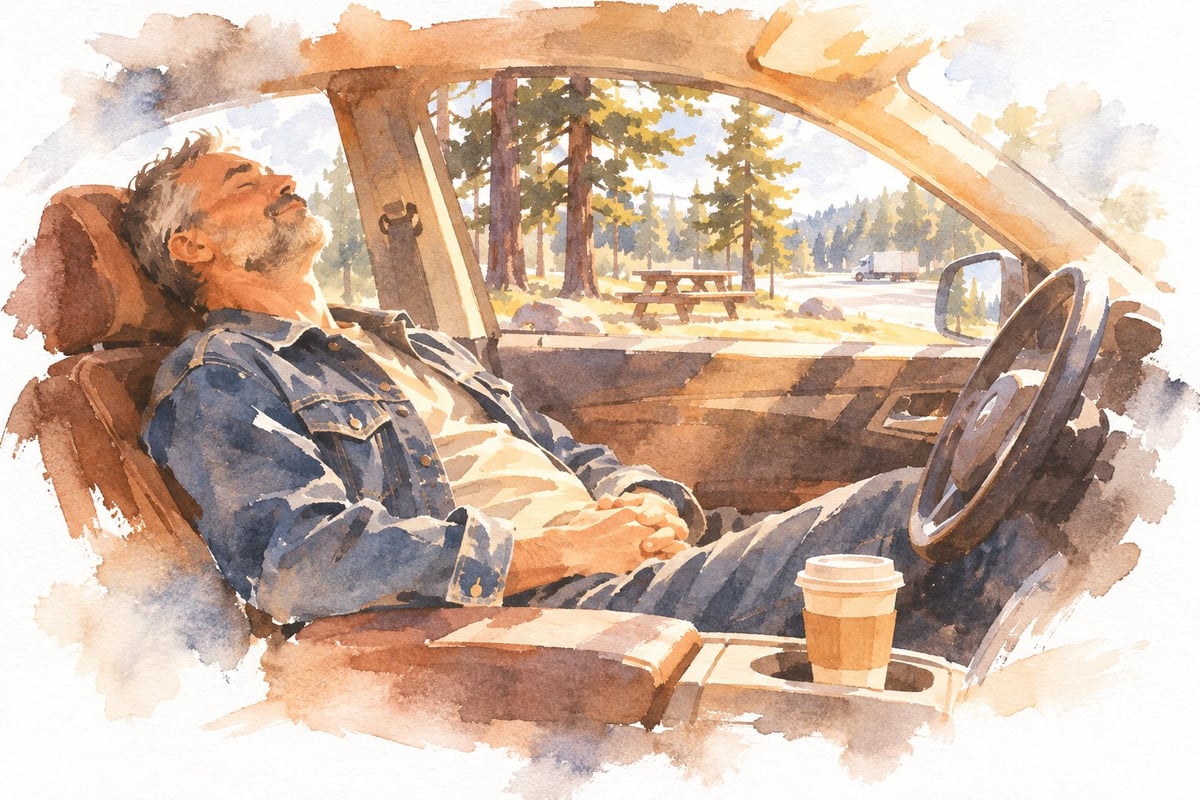
If you hit a wall in the early afternoon and have 20 minutes, drink a coffee, then lie down right away and set an alarm for 15 minutes. It’s fine if you only doze. Use a small cup and keep it to the early afternoon, so it doesn’t follow you to bed. And if you’re fighting sleep behind the wheel, pull over somewhere safe and stop driving.
If you remember three things
- Together they beat either one. Driving errors fell to 9% of the placebo level, against 34% for caffeine alone.
- The nap is short. It lasted under 15 minutes, and even light dozing worked.
- Time it early. 200 mg at 2pm still leaves about 64 mg at 11pm, and an 8 oz coffee about 30.
Why it sounds too good
Coffee before a nap sounds backwards. Caffeine is supposed to stop you sleeping, so drinking it right before you lie down seems like it would ruin the nap. And it gets passed around online as a trick, which makes people suspicious of it.
The timing is what makes it work. Caffeine takes time to get going. Almost all of a cup is absorbed within 45 minutes, and the level in your blood peaks somewhere from 15 minutes to 2 hours after you drink it. A short nap fits inside that gap. It’s like putting the kettle on before you shower. By the time you’re out, it’s ready.
What the study found
Coffee, a nap, both, or neither
12 sleepy people in a car simulator. Reyner and Horne, Loughborough University Sleep Research Laboratory, 1997
In a 30 minute break before a 2 hour monotonous afternoon drive, people had 200 mg of caffeine followed by a nap of under 15 minutes, caffeine alone, or a placebo. The combination cut driving incidents to 9% of the placebo level, and caffeine alone to 34%. The combination removed the usual mid-afternoon peak in sleepiness.
Twelve people, one simulator, one dose, in the afternoon.
The researchers found that naps made up of “nonsleep dozing” still worked, so you don’t have to fall deeply asleep. Earlier research had shown that caffeine and a short nap each reduced drivers’ sleepiness on their own, for about an hour.
Why the two help each other
Adenosine, the chemical that builds up while you’re awake and makes you sleepy, falls during sleep, so even a short nap may clear a little of it. Caffeine then blocks the receptors for what’s left. The nap lowers the pile, and the caffeine covers the rest. What caffeine actually does explains the adenosine side.
The best case against it
It’s one study of 12 people from 1997, in a simulator, with one dose and one time of day. It didn’t test the trick at night, in shift workers or with a smaller coffee. And 200 mg is about two 8 oz cups. Taken at 2pm it still leaves about 64 mg in you at an 11pm bedtime, and at 3pm about 73, which can cost you part of tonight’s sleep in exchange for the afternoon. A single 8 oz coffee at 2pm leaves about 30 mg.
More detail: how to do one
Drink the coffee fairly quickly, an 8 oz cup or an espresso. Lie down straight away somewhere you can rest, and set an alarm for 15 minutes so you don’t fall into a long, deep nap. Get up when it goes off, even if you think you didn’t sleep. Do it before about 2pm for an 11pm bedtime, and check the cutoff clock if your day runs differently.
4 sources
- Reyner LA, Horne JA, Suppression of sleepiness in drivers: combination of caffeine with a short nap, Psychophysiology, 1997pubmed.ncbi.nlm.nih.gov
- Antonio J and others, Common questions and misconceptions about caffeine supplementation: what does the scientific evidence really show?, Journal of the International Society of Sports Nutrition, 2024doi.org
- Reichert CF, Deboer T, Landolt HP, Adenosine, caffeine, and sleep-wake regulation: state of the science and perspectives, Journal of Sleep Research, 2022doi.org
- USDA FoodData Central, brewed coffee (FDC 171890), SR Legacyfdc.nal.usda.gov