When to stop, by the size of the cup
On this page
Go by the cup, not the clock. For an 11pm bedtime, finish a 16 oz coffee by about 11am, an 8 oz coffee by about 4pm, and a single espresso or a cup of tea by about 7pm. Each time you double the size of the cup, stop about 5 hours earlier, and keep caffeine at least 4 hours away from bed.
What we’d do
After lunch, have one small cup. The big doses, a 16 oz coffee, a CELSIUS or a Monster, a pre-workout scoop, belong in the morning. If you love your afternoon coffee, shrink it before you move it. An 8 oz cup at 4pm leaves about the same in you at 11pm as a 16 oz cup at noon.
If you remember three things
- The cup sets the hour. An 8 oz coffee needs about 7 hours before bed, a 16 oz about 12, and a full pre-workout scoop about 14.
- One small cup after lunch is fine for most people. In a 2025 trial, 100 mg taken 4 hours before bed did nothing measurable.
- Shrinking beats moving. A 16 oz coffee at noon and an 8 oz at 4pm leave about the same at 11pm, 46 mg and 40 mg.
Why does every rule give a different hour?
Search for when to stop drinking coffee and you’ll find 6 hours, about 9 hours and 13 hours, all from real research.
The 6 hours comes from the 2013 study at Henry Ford Hospital in Detroit, where 400 mg taken 6 hours before bed still cut more than an hour of sleep. The 8.8 hours comes from a 2023 review of 24 studies, worked out for a 107 mg coffee. The 13.2 hours is the same review’s number for a 217.5 mg pre-workout scoop. Each rule is right for its own dose, and people argue about which one is true without noticing the doses were different.
The whole thing in one picture
You leave for the airport earlier when you live an hour away than when you live ten minutes away. Nobody thinks there’s one right time to leave the house. It depends how far you have to go.
A bigger cup is a longer drive. It has further to fall before it’s under the line at bedtime, so it needs a bigger head start.
Why doubling the cup adds about 5 hours
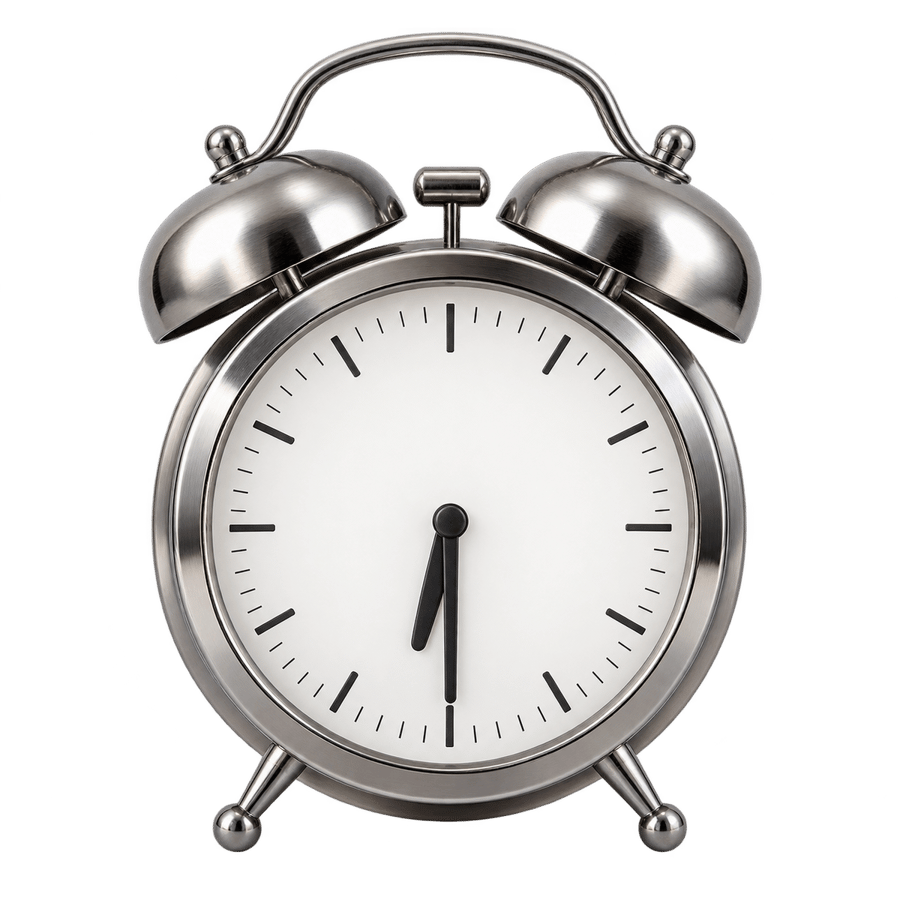
- Your liver clears a share, not a set amount. It clears about half of whatever is in you every 5 hours, whether that’s 400 mg or 40.
- So a bigger cup takes longer to fall to the same level. An 8 oz coffee (95 mg) takes about 7 hours to fall under 40 mg. A 16 oz coffee (190 mg) takes about 12. Two 16 oz coffees at once would take about 17.
- Every doubling adds one half-life. Twice the cup means one more halving to get back to the same place, about 5 more hours.
That’s why the hour on the clock can’t be one number for every drink.
The latest time for each drink
This is the latest time to finish each drink and still fall asleep with under 40 mg in you, on a 5 hour half-life. Nothing goes later than 4 hours before sleep.
| Last drink | Caffeine | Hours before sleep | Asleep at 10pm | Asleep at 11pm | Asleep at midnight |
|---|---|---|---|---|---|
| Single espresso | 63 mg | 4 | 6:00pm | 7:00pm | 8:00pm |
| Black tea, 8 oz | 47 mg | 4 | 6:00pm | 7:00pm | 8:00pm |
| Red Bull, 8.4 oz | 80 mg | 5.8 | 4:15pm | 5:15pm | 6:15pm |
| Coffee, 8 oz | 95 mg | 7 | 3:00pm | 4:00pm | 5:00pm |
| Double espresso | 126 mg | 9 | 1:00pm | 2:00pm | 3:00pm |
| Coffee, 12 oz | 142 mg | 9.9 | 12:05pm | 1:05pm | 2:05pm |
| Monster, 16 oz | 160 mg | 10.8 | 11:15am | 12:15pm | 1:15pm |
| Coffee, 16 oz | 190 mg | 12 | 10:00am | 11:00am | noon |
| CELSIUS, 12 oz | 200 mg | 12.4 | 9:40am | 10:40am | 11:40am |
| Pre-workout scoop, average | 254 mg | 14.1 | 7:55am | 8:55am | 9:55am |
Coffee and tea come from USDA, the cans from Red Bull and the can labels, and the scoop from the average of the 100 top-selling pre-workouts. The cutoff clock does this for your own drinks, your own bedtime and any earlier cups.
Our two lines, and the 4 hour floor
The 40 mg line is low on purpose. The 2023 review’s two cutoffs, the coffee at 8.8 hours and the scoop at 13.2, both leave 35 to 39 mg at bedtime on this math, so under 40 is where that review’s advice would put you.
Above 80 mg is where a trial measured a cost. In the 2025 trial, 400 mg taken 12 hours before bed leaves about 84 mg at bedtime, and it cut about 21 minutes of deep sleep. Between the two lines, the same trial’s 100 mg at 4 hours leaves about 64 mg and did nothing measurable. If you’d rather go by the higher line, for an 11pm bedtime you can finish a 16 oz coffee by about 4pm, a CELSIUS by about 3:40pm, a Monster by about 5:15pm and a full scoop by about 2pm.
The 4 hour floor is there because the trials behind these lines never gave a small dose closer to bed than that. The 2013 study that went closer used 400 mg, at bedtime and 3 hours before, and it cut more than an hour of sleep.
Earlier cups count too
The table is for your last drink on its own. An 8 oz coffee at 8am still leaves about 13 mg at 11pm, so add a 4pm cup and you go to sleep with about 53 mg. A 16 oz coffee at 7am leaves about 23 mg, and the same 4pm cup takes you to about 63 mg.
Both days sit between our lines, under the 64 mg that showed nothing in the 2025 trial. To get the second day under 40 mg, the afternoon cup would have to come by about 10am, and at that point you’d do better to make it smaller. For most people, a morning coffee plus one small cup after lunch lands in that middle band, where the one trial that tested it found nothing.
Who it moves for
- On the pill. The half-life is about 1.5 times longer, so the 8 oz coffee for an 11pm bedtime moves from 4pm to about 1pm.
- Heavy smokers. About a third shorter, so the same coffee can go to about 6pm. In the week after you quit, it moves back.
- Late in pregnancy. At about 10.5 hours, the 8 oz coffee would have to come by about 9am, and the 200 mg a day line comes first anyway.
- Night shift. Count everything from when you fall asleep, never from the clock. For an 8:30am sleep, an 8 oz coffee by about 1:30am and an espresso by about 4:30am. If you’re too sleepy to drive home, don’t drive.
What makes yours faster or slower has the studies behind each one.
Your turn
Put in what you drink and when you fall asleep, and the cutoff clock gives your latest time for the drink you actually have, plus what’s still in you at 3am. The quiz, Is my coffee keeping me up?, adds the one change for tonight.
12 sources
- Gardiner C and others, Dose and timing effects of caffeine on subsequent sleep: a randomized clinical crossover trial, Sleep, 2025doi.org
- Gardiner C and others, The effect of caffeine on subsequent sleep: a systematic review and meta-analysis, Sleep Medicine Reviews, 2023doi.org
- Drake C, Roehrs T, Shambroom J, Roth T, Caffeine effects on sleep taken 0, 3, or 6 hours before going to bed, Journal of Clinical Sleep Medicine, 2013pmc.ncbi.nlm.nih.gov
- Antonio J and others, Common questions and misconceptions about caffeine supplementation: what does the scientific evidence really show?, Journal of the International Society of Sports Nutrition, 2024doi.org
- Abernethy DR, Todd EL, Impairment of caffeine clearance by chronic use of low-dose oestrogen-containing oral contraceptives, European Journal of Clinical Pharmacology, 1985pubmed.ncbi.nlm.nih.gov
- Faber MS, Fuhr U, Time response of cytochrome P450 1A2 activity on cessation of heavy smoking, Clinical Pharmacology and Therapeutics, 2004pubmed.ncbi.nlm.nih.gov
- Knutti R, Rothweiler H, Schlatter C, The effect of pregnancy on the pharmacokinetics of caffeine, Archives of Toxicology Supplement, 1982pubmed.ncbi.nlm.nih.gov
- USDA FoodData Central, brewed coffee (171890), espresso (171891), brewed black tea (173227), SR Legacyfdc.nal.usda.gov
- Red Bull, How much caffeine is in a can of Red Bull?, checked 2026-11-14redbull.com
- Open Food Facts, Monster Energy 16 fl oz can (UPC 070847811169), 160 mg caffeine per can from the label, checked 2026-11-14world.openfoodfacts.org
- Open Food Facts, CELSIUS Sparkling Kiwi Guava 12 fl oz can (UPC 889392010145), 200 mg caffeine per can from the label, checked 2026-11-14world.openfoodfacts.org
- Jagim AR, Harty PS, Camic CL, Common ingredient profiles of multi-ingredient pre-workout supplements, Nutrients, 2019doi.org