Where the real risks are
On this page
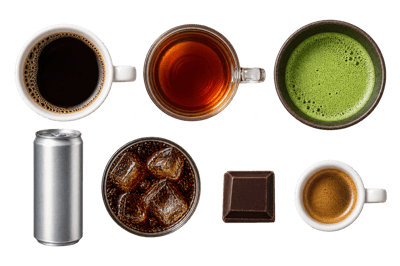
Most of the risk around caffeine is in what comes with it. A sugary drink, an energy drink chugged in an hour, coffee brewed without a paper filter, a drink that’s scalding hot, or a spoon of pure powder. The rest is timing and dose, which is the cup that’s still in you at bedtime.
Coffee and tea themselves come out well in the big studies (is coffee healthy? has them). When a “caffeine” headline worries you, it helps to ask what the caffeine came in. Blaming the caffeine for a 16 oz frappuccino is like blaming the lettuce for a double cheeseburger.
What we’d do
Drink coffee and tea close to black. If you drink a lot of coffee and your LDL is high, brew it through a paper filter.
Treat sweet coffee drinks and sodas as dessert, and energy drinks as an occasional thing for adults only.
Let hot drinks cool for a few minutes, and never keep pure caffeine powder at home.
The sugar
A 12 oz can of Coca-Cola has 34 mg of caffeine, about a third of an 8 oz coffee, and 39 g of sugar. The FDA’s Daily Value for added sugar is 50 g a day, so one can is most of a day’s limit. The caffeine is the small part of that drink. meals.guide has the sugar limit for one meal.
Coffee shows the same thing. A 2025 study followed about 46,000 American adults from 1999 to 2018. Black coffee went with a 14% lower risk of dying than no coffee, and so did coffee with less than about half a teaspoon of sugar (2.5 g) and about a tablespoon of half-and-half per 8 oz cup. Coffee with a lot of added sugar and fat showed no lower risk.
A spoon of sugar doesn’t seem to undo it. In a 2022 UK study of 171,616 people, 1.5 to 3.5 sugar-sweetened coffees a day still went with a 28 to 31% lower risk of dying. At more than 4.5 sweetened coffees a day, the lower risk was gone. A teaspoon in your cup is a different drink from a syrup-and-whipped-cream one.
Energy drinks
An energy drink isn’t always stronger than coffee. An 8.4 oz Red Bull has 80 mg, less than an 8 oz coffee. But the FDA says energy drinks run from 54 to 328 mg per 16 oz.
In a 2019 trial, 34 healthy young adults drank 32 oz of an energy drink within an hour. It lengthened the QT interval, a measure of the heart’s electrical reset, by about 18 to 20 milliseconds against 12 for a placebo drink, and raised blood pressure. The researchers wrote that energy drinks “significantly prolong the QTc interval and raise blood pressure”.
For children and teens, the American Academy of Pediatrics says the caffeine and other stimulants in energy drinks “have no place” in their diet. How much caffeine can a teenager have?
Unfiltered coffee
Coffee beans carry two oily compounds, cafestol and kahweol, that raise cholesterol. Researchers measured how much of them ends up in a cup brewed each way, and the filter turned out to be the difference.
The filter is the difference
A review of 14 trials found that more coffee meant higher total and LDL cholesterol, mostly with boiled coffee, and that trials of filtered coffee showed very little rise. In the researchers’ words, “Consumption of unfiltered, but not filtered, coffee increases serum levels of total and LDL cholesterol.”
It shows up in long-term results too. In Norway, 508,747 people were followed for 20 years.
Dying over 20 years, by how the coffee was made
- Filtered, men15% lower
- Filtered, women15% lower
- Unfiltered, men4% lower
- Unfiltered, women9% lower
Espresso sits in the middle. It’s brewed without a paper filter, but a shot is small, so it carries about 1.5 mg of cafestol against 3.5 mg in a cup of French press. In northern Norway, 21,083 adults over 40 had their cholesterol checked in 2015 and 2016. Three to five espressos a day went with total cholesterol about 6 mg/dL (0.16 mmol/L) higher in men and about 3.5 mg/dL (0.09 mmol/L) higher in women. Six or more cups of boiled or French press coffee went with about 9 to 12 mg/dL (0.23 to 0.30 mmol/L) higher.
Those are small numbers for one person. If your LDL is high, or you drink a lot of French press, switching to a paper filter is an easy change. cholesterol.guide has the trials in more detail.
Very hot drinks
In 2016 the World Health Organization’s cancer agency found that drinking very hot drinks, above 65°C (149°F), probably causes cancer of the esophagus. The studies came from places where tea or maté is drunk at about 70°C, and the risk rose with the temperature. The agency’s director said “it is the temperature, rather than the drinks themselves” that appears to be responsible. A review of tea studies found the same for tea hotter than about 55 to 60°C.
The same agency found no conclusive evidence that coffee causes cancer. A few minutes on the counter is all a fresh cup needs.
Pure caffeine powder and pills
From drinks, caffeine is very hard to overdo. Pure powder is the danger. The FDA says toxic effects like seizures can come from rapid intake of around 1,200 mg, and that’s less than half a teaspoon of pure caffeine. Don’t keep it at home. If someone has swallowed some, call Poison Control at 1-800-222-1222, or 911 if they collapse, have a seizure or can’t be woken. Can you overdose on caffeine?
Pills and pouches are measured doses. A caffeine pill is usually 200 mg and a pouch holds anywhere from 3 to 200, so the label tells you what you’re getting, but they’re easy to stack (are caffeine pills bad for you?, are caffeine pouches safe?).
Pregnancy
In the 2017 review of coffee studies, pregnancy was the one place where the harmful links held up after adjusting for smoking. High coffee intake went with lower birth weight, preterm birth and pregnancy loss. The US advice from ACOG is under 200 mg a day, about two 8 oz coffees, and late in pregnancy caffeine also clears about three times slower. How much caffeine can you have while pregnant?
The late cup
The last risk is about timing. Half of a cup is still in you about 5 hours later, and a big dose still cut deep sleep 12 hours before bed in a 2025 trial. When to stop, by the size of the cup and what caffeine does to your night cover that half of the story, and how much is too much has the daily lines.
19 sources
- The Coca-Cola Company, Coca-Cola Original Taste, product details and FAQ, checked 2026-11-15coca-cola.com
- US Food and Drug Administration, Added sugars on the Nutrition Facts label, checked 2026-11-15fda.gov
- Zhou B and others, Coffee consumption and mortality among US adults (NHANES 1999 to 2018), Journal of Nutrition, 2025, summary by Tufts Universitynow.tufts.edu
- Liu D and others, Association of sugar-sweetened, artificially sweetened, and unsweetened coffee consumption with all-cause and cause-specific mortality, Annals of Internal Medicine, 2022doi.org
- US Food and Drug Administration, Spilling the beans: how much caffeine is too much?, content current as of 2024-08-28fda.gov
- Shah SA and others, Impact of high volume energy drink consumption on electrocardiographic and blood pressure parameters: a randomized trial, Journal of the American Heart Association, 2019doi.org
- American Academy of Pediatrics, Sports drinks and energy drinks for children and adolescents: are they appropriate?, Pediatrics, 2011pubmed.ncbi.nlm.nih.gov
- Urgert R and others, Levels of the cholesterol-elevating diterpenes cafestol and kahweol in various coffee brews, Journal of Agricultural and Food Chemistry, 1995doi.org
- Jee SH and others, Coffee consumption and serum lipids: a meta-analysis of randomized controlled clinical trials, American Journal of Epidemiology, 2001doi.org
- Svatun AL and others, Association between espresso coffee and serum total cholesterol: the Tromso Study 2015 to 2016, Open Heart, 2022doi.org
- Tverdal A and others, Coffee consumption and mortality from cardiovascular diseases and total mortality: does the brewing method matter?, European Journal of Preventive Cardiology, 2020doi.org
- International Agency for Research on Cancer, IARC Monographs evaluate drinking coffee, mate, and very hot beverages, press release 244, June 15, 2016iarc.who.int
- Yi M and others, Tea consumption and health outcomes: umbrella review of meta-analyses of observational studies in humans, Molecular Nutrition and Food Research, 2019doi.org
- Poole R and others, Coffee consumption and health: umbrella review of meta-analyses of multiple health outcomes, BMJ, 2017doi.org
- American College of Obstetricians and Gynecologists, Committee Opinion No. 462: Moderate caffeine consumption during pregnancy, Obstetrics and Gynecology, 2010pubmed.ncbi.nlm.nih.gov
- Poison Control, America's Poison Centerspoison.org
- US National Library of Medicine, DailyMed, Vivarin (caffeine) tablet label, updated May 1, 2026dailymed.nlm.nih.gov
- Grinds, Frequently asked questions, checked 2026-11-15getgrinds.com
- American Academy of Pediatrics, The effects of caffeine on kids: a parent's guide, HealthyChildren.org, updated August 11, 2025healthychildren.org