What caffeine does to your night
On this page
Caffeine still in you at bedtime does most of its damage after you’re already asleep. Across 24 studies it cut total sleep by about 45 minutes and deep sleep by about 11, and added 12 minutes awake in the night. It added only 9 minutes to falling asleep. You drop off almost as fast as usual, so you never find out what you lost.
What we’d do
Judge your caffeine by your mornings and your tracker, not by how fast you fall asleep. If you wake up tired, or wake around 3am and can’t get back down, move your last cup earlier or make it smaller for two weeks before you blame anything else. Aim to have under about 40 mg left at bedtime, which for most people means one small cup after lunch and nothing big after the morning.
If you remember three things
- Falling asleep is the part that changes least. It took about 9 minutes longer, against 45 minutes off the whole night.
- A big dose costs deep sleep even from 12 hours away. In a 2025 trial, 400 mg taken 12 hours before bed cut about 21 minutes of it.
- Most people can’t tell. In one study the diaries counted 41 minutes lost, where a monitor measured more than an hour.
Why do so many people think coffee doesn’t touch their sleep?
They fall asleep, and that’s the test almost everyone uses. You have a coffee at 4pm, you’re out by 11, and the coffee gets a clean bill.
Falling asleep is the one part of the night caffeine barely moves. In 2023 a group of sleep researchers at the Australian Catholic University pooled 24 studies. Caffeine added 9 minutes to falling asleep. It took 45 minutes off total sleep, cut deep sleep by 11 minutes, added 6 minutes of the lightest stage of sleep, and added 12 minutes awake after people had dropped off.
The whole thing in one picture
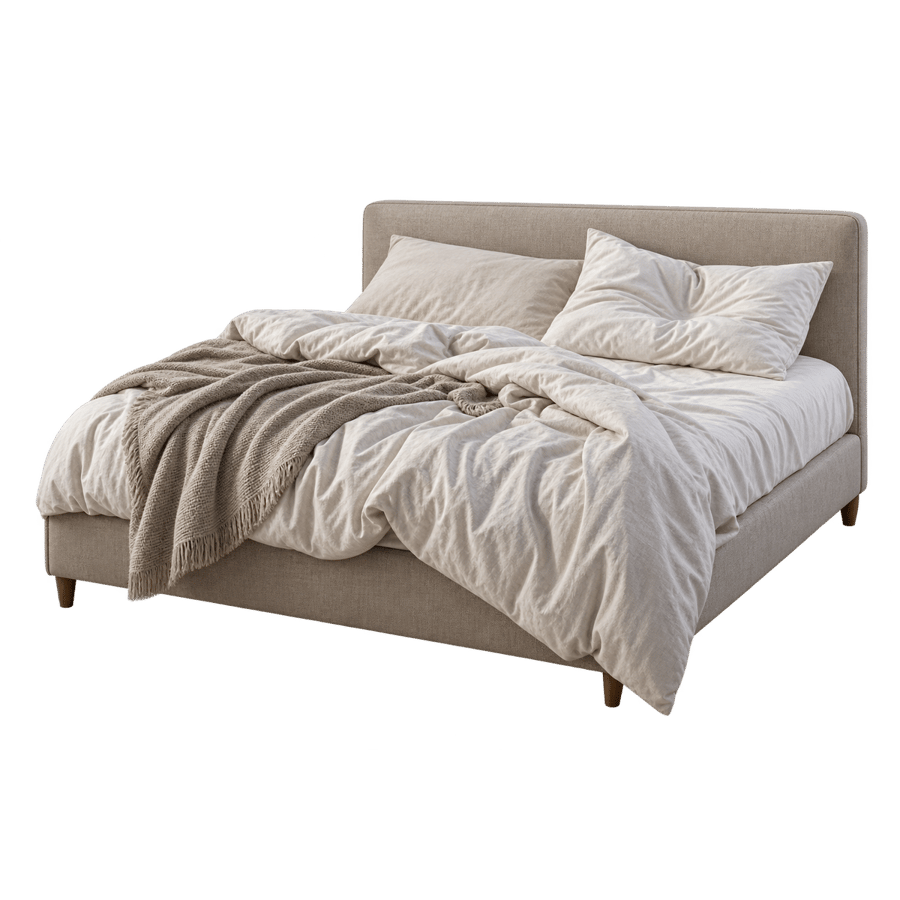
Sleeping with caffeine in you is like sleeping with the hall light on and the bedroom door open a crack. You still fall asleep. But the night runs lighter, you surface more often, and in the morning you can’t say exactly what was different.
What happens across the night
- The day’s adenosine pushes you down. Adenosine builds up the longer you’re awake, and it’s one of the things that drives deep sleep, which comes mostly in the first part of the night.
- Caffeine left over sits in the way. Whatever is still in you at bedtime is sitting in some of adenosine’s receptors.
- Deep sleep gets shallower. You get less deep sleep, more of the lightest sleep, and more waking in the night.
- Falling asleep looks normal. After a full day awake you still drop off nearly on time, so the change hides after you’re already asleep.
What the trials found
Twenty-four studies pooled
Gardiner and colleagues, Sleep Medicine Reviews, 2023
Caffeine cut total sleep by 45 minutes and sleep efficiency by 7%. Falling asleep took 9 minutes longer, time awake after falling asleep rose 12 minutes, and deep sleep fell 11.4 minutes.
The studies used different doses and timings, so the averages blur the role of each.
Two doses at three times
23 young men, seven nights each. Gardiner and colleagues, Sleep, 2025
100 mg did nothing measurable at 12, 8 or 4 hours before bed. 400 mg at 4 hours cut 51 minutes of sleep and 30 of deep sleep. At 8 hours it cut 15 minutes of deep sleep and added 29 minutes awake. At 12 hours it still cut 21 minutes of deep sleep.
Young men only, measured at home with a forehead device rather than in a sleep lab.
400 mg at bedtime, 3 or 6 hours before
12 good sleepers aged 19 to 48. Drake and colleagues, Henry Ford Hospital, 2013
Every timing cut 1.1 to 1.2 hours of measured sleep, including the dose 6 hours before bed.
Small, and paid for by a grant from the maker of the headband monitor it used.
Daily drinkers, 10 days
20 young men who drink caffeine every day. Weibel and colleagues, University of Basel, 2021
150 mg three times a day, the last 8 hours before bed, left total sleep, falling asleep, sleep stages and how well they felt they slept the same as on placebo. One brain wave band was lower.
Twenty good sleepers who were used to caffeine, so it may not hold for poor sleepers or big doses.
The 2025 grid puts dose and time side by side. The small cup did nothing at any hour. The big dose cost something at every hour, and it cost more the closer it came to bed. That’s why we say the cup beats the clock, and why when to stop goes by the size of your drink.
Why can’t you feel it?
In the 2013 study at Henry Ford Hospital, the diaries picked up the damage from caffeine at bedtime and 3 hours before. At 6 hours they counted 41 minutes lost, too little to be sure of, while the monitor measured more than an hour. The authors wrote that this gap in what people notice may be why they don’t follow advice to avoid caffeine before bed.
The 2025 trial found the same thing. The men only rated their sleep worse after 400 mg 4 hours before bed, when it fell by 34%. At 8 and 12 hours, with deep sleep still down, they didn’t feel a difference. And only 22% of them could say both which dose they’d had and when.
The best case that your coffee is fine
The Basel study is the strongest evidence on the other side. On our 5 hour math those 20 men went to bed with about 110 mg still in them, more than the 80 mg where we draw our upper line, and their sleep looked like placebo. Moderate cups spread through the day, in people used to them, seem to cost much less than one big dose.
We still keep the late cup small. The 2025 trial’s men also drank caffeine every day, and a single big dose cost them deep sleep from 12 hours away. Adults over about 40 have been shown to be more sensitive to caffeine’s effect on sleep, and both of these trials were in young men. And since you can’t feel the cost either way, your own nights are the only way to know which group you’re in.
What a 3am wake-up has to do with it
Waking in the night is something a ring or watch can show you. Across the 24 studies caffeine added about 12 minutes awake after falling asleep, and 400 mg taken 4 or 8 hours before bed added 26 to 29 minutes in the 2025 trial. A 4pm 16 oz coffee still leaves about 80 mg at 11pm and about 45 mg at 3am on a 5 hour half-life.
If you track HRV too, hrv.guide found that caffeine near bedtime didn’t lower HRV during sleep in lab trials. The cost runs through shorter, lighter sleep.
Test it on yourself
Keep everything the same for a week. Then spend a week with your last cup at least 7 hours before bed, or swapped for something smaller, and compare. With a ring or watch, look at deep sleep and time awake, averaged over the week. Without one, write down each morning how long you took to fall asleep and how rested you feel on a scale of 1 to 5. The quiz, Is my coffee keeping me up?, tells you which part of the night to watch for your answers.
5 sources
- Gardiner C and others, The effect of caffeine on subsequent sleep: a systematic review and meta-analysis, Sleep Medicine Reviews, 2023doi.org
- Gardiner C and others, Dose and timing effects of caffeine on subsequent sleep: a randomized clinical crossover trial, Sleep, 2025doi.org
- Drake C, Roehrs T, Shambroom J, Roth T, Caffeine effects on sleep taken 0, 3, or 6 hours before going to bed, Journal of Clinical Sleep Medicine, 2013pmc.ncbi.nlm.nih.gov
- Weibel J and others, The impact of daily caffeine intake on nighttime sleep in young adult men, Scientific Reports, 2021doi.org
- Reichert CF, Deboer T, Landolt HP, Adenosine, caffeine, and sleep-wake regulation: state of the science and perspectives, Journal of Sleep Research, 2022doi.org