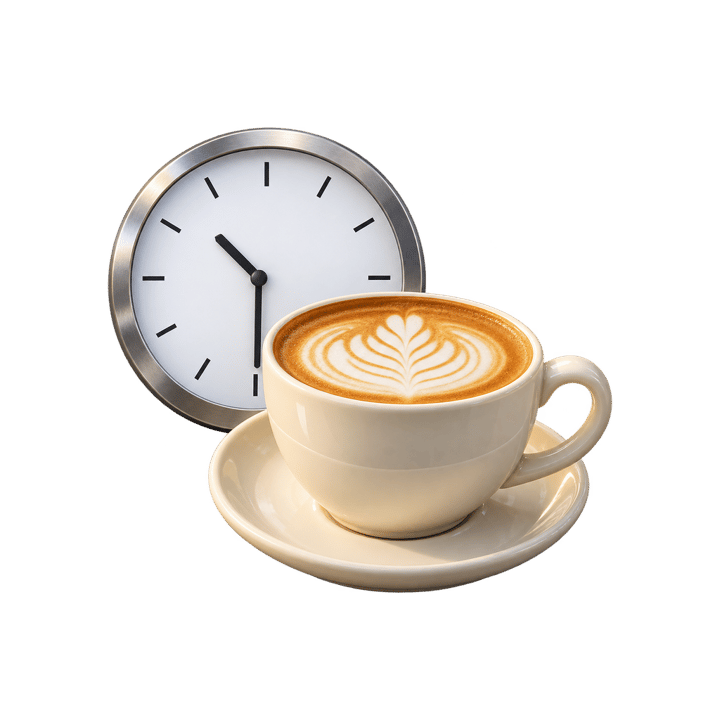
The cup sets the dose
On this page
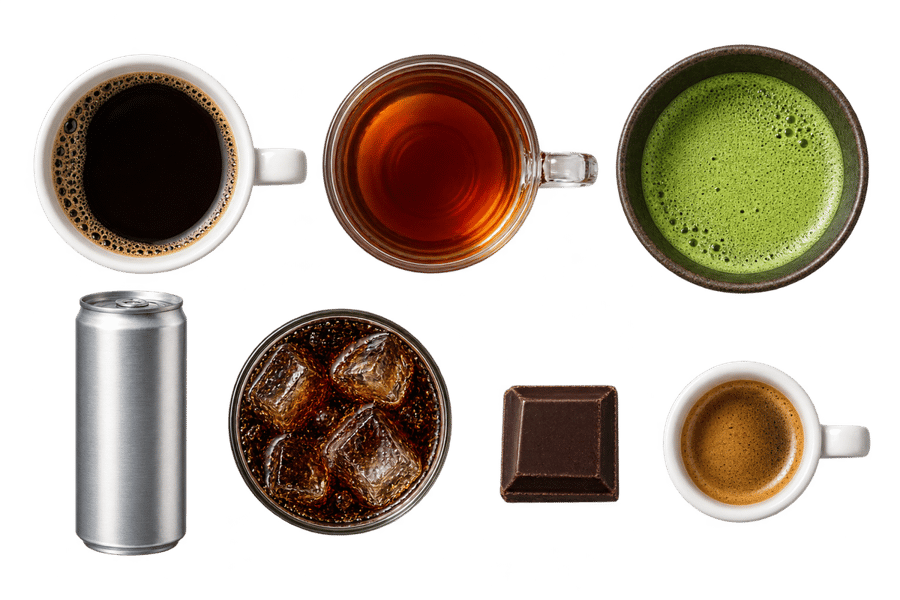
An 8 oz cup of brewed coffee has about 95 mg of caffeine, a shot of espresso about 63, a cup of black tea about 47 and a can of Coke 34. The size of the cup sets your dose more than the kind of drink, and coffee-shop cups vary the most. One shop’s drink measured anywhere from 259 to 564 mg on six days in a row.
What we’d do
Count ounces, not cups. Know the size of your usual coffee before you set any cutoff, because a 16 oz cup is two 8 oz cups as far as your night is concerned. After lunch, order the small one or switch to tea. Read the label on any can or scoop, since energy drinks and pre-workouts range from less than a coffee to more than three.
If you remember three things
- A single espresso has less caffeine than an 8 oz drip coffee. It has about 63 mg against 95. It’s stronger per sip, but a shot is only 1 oz.
- Coffee-shop coffee is the wild card. A 16 oz cup averaged 188 mg in one lab test, and single servings ran from 58 to 259.
- Cans aren’t all alike. An 8.4 oz Red Bull has 80 mg, less than a coffee. A 12 oz CELSIUS has 200, about two.
Why doesn’t “a cup of coffee” tell you much?
People count cups. Two coffees a day sounds like the same habit whether that’s two mugs at home or two large cups from a coffee shop, and the strong drink everyone pictures is espresso.
“A cup of coffee” is like “a slice of pizza”. A slice from a small pie and a slice from an extra large pie are both a slice, and one of them is twice the food. A coffee shop’s 16 oz cup holds twice the caffeine of an 8 oz mug of the same coffee, before you even ask how strong it was brewed.
In 2003 a lab team bought specialty coffees from coffee shops and measured the caffeine in each one. A serving held anywhere from 58 to 259 mg, and the 16 oz brewed cups averaged 188 mg. Then they bought the same drink from the same shop on six days in a row. It came out at 259 mg on one day and 564 mg on another, more than double, for the same order at the same counter.
How the dose works
Caffeine dissolves out of the beans or leaves into the water, so the dose is how strong the drink is times how much of it you drink.
By USDA’s lab numbers, espresso holds 212 mg of caffeine per 100 g and brewed coffee 40 mg. Ounce for ounce, espresso is about five times stronger. But a shot is 1 oz and a mug is 8, so the mug wins, 95 mg to 63. A double espresso, at about 126 mg, is where espresso finally passes the mug.
Tea works the same way at a lower strength, about 20 mg per 100 g for brewed black tea and 12 for green. Matcha is different, because you drink the whole leaf ground into powder instead of soaking it and throwing it away. Two lab tests found 16 and 42 mg per gram of matcha powder, so a 2 gram bowl holds somewhere from about 32 to 84 mg, and a strong bowl can match a cup of coffee.
The drinks, side by side
| Drink | Size | Caffeine | Where the number comes from | To reach 400 mg | One at 3pm leaves at 11pm |
|---|---|---|---|---|---|
| Decaf coffee | 8 oz | 2 to 15 mg | FDA | About 27 | 5 mg or less |
| Green tea | 1 cup | 29 mg | USDA | About 14 | 11 mg |
| Coca-Cola | 12 oz can | 34 mg | Coca-Cola | About 12 | 12 mg |
| Diet Coke | 12 oz can | 46 mg | Coca-Cola | About 9 | 17 mg |
| Black tea | 8 oz | 47 mg | USDA | About 8.5 | 17 mg |
| Matcha | 2 g of powder | About 32 to 84 mg | Two lab tests | About 5 to 12 | 21 mg at the middle |
| Espresso | 1 shot | 63 mg | USDA | About 6 | 23 mg |
| Red Bull | 8.4 oz can | 80 mg | Red Bull | 5 | 29 mg |
| Brewed coffee | 8 oz | 95 mg | USDA | About 4 | 35 mg |
| Red Bull | 12 oz can | 114 mg | Red Bull | About 3.5 | 42 mg |
| Espresso, double | 2 shots | 126 mg | USDA | About 3 | 46 mg |
| Brewed coffee | 12 oz | 142 mg | USDA | About 3 | 52 mg |
| Red Bull | 16 oz can | 151 mg | Red Bull | About 2.5 | 55 mg |
| Monster | 16 oz can | 160 mg | Can label | About 2.5 | 59 mg |
| Coffee-shop brewed coffee | 16 oz | 188 mg on average | Lab test, 2003 | About 2 | 69 mg |
| Brewed coffee | 16 oz | 190 mg | USDA | About 2 | 70 mg |
| Red Bull | 20 oz can | 198 mg | Red Bull | 2 | 72 mg |
| CELSIUS | 12 oz can | 200 mg | Can label | 2 | 73 mg |
| Pre-workout | 1 scoop | 254 mg on average | Top 100 products, 2019 | About 1.5 | 93 mg |
The 11pm column uses a 5 hour half-life. Monster and CELSIUS come from current can labels, and recipes change, so check the can in your hand. The drink calculator draws each one to scale against a cup of coffee.
The ones that surprise people
- Espresso is the gentle one. A single shot has less caffeine than an 8 oz drip coffee, and it’s one of the easier drinks to fit in the afternoon. There’s more on espresso against coffee.
- Diet Coke has more than Coke. 46 mg against 34 in a 12 oz can, by Coca-Cola’s own numbers.
- The small Red Bull is milder than a coffee. Red Bull says its 8.4 oz can has “about the same amount as in a cup of home-brewed coffee”, and by USDA’s 95 mg it’s a bit less. The 20 oz can has 198.
- A CELSIUS is two coffees. 200 mg in a 12 oz can is about two 8 oz coffees, or about six cans of Coke.
- Decaf isn’t zero. The FDA says an 8 oz cup typically has 2 to 15 mg. In a 2006 lab test, 10 decafs from different shops held 0 to 13.9 mg per 16 oz, and one chain’s decaf espresso 3 to 16 mg a shot.
Does the roast or the brew change it?
A little, and often the opposite way from what people expect. In a 2024 study at Berry College in Georgia, coffees brewed the same way came out generally lower in caffeine as dark roasts than as light and medium roasts. The bold taste of a dark roast isn’t extra caffeine (dark roast).
Cold brew tastes milder, and people assume it’s weaker. In a 2017 lab test in Philadelphia, cold brew made from coarse-ground coffee had substantially more caffeine than hot coffee made with the same coffee and the same amount of water (cold brew).
Energy drinks and pre-workouts
The FDA puts energy drinks at 54 to 328 mg per 16 oz, so “an energy drink” can mean less than a coffee or more than three. Pre-workouts are bigger again. When researchers went through the labels of the 100 top-selling pre-workout products in 2019, 86% had caffeine, and the average was 254 mg a serving, give or take about 80. Nearly half of all the ingredients were in proprietary blends, with no amount given.
A scoop at 5pm still leaves about half of itself in you at 11pm. Caffeine for training has the dose for your weight and the latest time for a full scoop or half of one.
Your turn
Pick your drink and size in the drink calculator, guess first, and see where it lands. Then add it to the cutoff clock at the time you usually have it.
13 sources
- USDA FoodData Central, brewed coffee (FDC 171890), restaurant espresso (171891), brewed black tea (173227), brewed green tea (171917), SR Legacyfdc.nal.usda.gov
- McCusker RR, Goldberger BA, Cone EJ, Caffeine content of specialty coffees, Journal of Analytical Toxicology, 2003pubmed.ncbi.nlm.nih.gov
- McCusker RR and others, Caffeine content of decaffeinated coffee, Journal of Analytical Toxicology, 2006pubmed.ncbi.nlm.nih.gov
- US Food and Drug Administration, Spilling the beans: how much caffeine is too much?, content current as of 2024-08-28, checked 2026-11-14fda.gov
- The Coca-Cola Company, What is caffeine? (FAQ), checked 2026-11-14coca-colacompany.com
- Red Bull, How much caffeine is in a can of Red Bull?, checked 2026-11-14redbull.com
- Open Food Facts, Monster Energy 16 fl oz can (UPC 070847811169), 160 mg caffeine per can from the label, checked 2026-11-14world.openfoodfacts.org
- Open Food Facts, CELSIUS Sparkling Kiwi Guava 12 fl oz can (UPC 889392010145), 200 mg caffeine per can from the label, checked 2026-11-14world.openfoodfacts.org
- Jagim AR, Harty PS, Camic CL, Common ingredient profiles of multi-ingredient pre-workout supplements, Nutrients, 2019doi.org
- Koláčková T and others, The effect of in vitro digestion on matcha tea (Camellia sinensis) active components and antioxidant activity, Antioxidants, 2022doi.org
- Mashaqbeh ET and others, Effects of matcha green tea on the pharmacokinetics of nadolol in rats, PLOS ONE, 2026doi.org
- Lindsey ZR and others, Caffeine content in filter coffee brews as a function of degree of roast and extraction yield, Scientific Reports, 2024doi.org
- Fuller M, Rao NZ, The effect of time, roasting temperature, and grind size on caffeine and chlorogenic acid concentrations in cold brew coffee, Scientific Reports, 2017doi.org