What caffeine actually does
On this page
Caffeine works by blocking adenosine, a chemical that builds up in your brain the longer you’re awake and makes you sleepy. Caffeine sits in adenosine’s receptors without switching them on. Adenosine keeps piling up behind it, so when the caffeine wears off, all that tiredness is still there.
What we’d do
Think of caffeine as a way to move tiredness around your day, and expect to pay it back. A morning cup borrows a little from the afternoon. A late cup borrows from tonight, out of the deep sleep that clears the adenosine away. Keep the late ones small, and if you need a coffee every afternoon to stay upright, look at your sleep before you add another cup.
If you remember three things
- Caffeine hides tiredness while it keeps building. The chemical that makes you sleepy piles up the whole time caffeine blocks it.
- The crash is the tiredness catching up. When caffeine falls, the adenosine that piled up gets through all at once.
- Deep sleep is where you pay. Adenosine helps drive deep sleep, and caffeine still in you at night blocks it there too.
Why does coffee feel like energy?
It feels like fuel. You drink it, you perk up, and it seems obvious that something got added. Most people picture caffeine as a kind of charge, like sugar for the brain.
Caffeine works by taking a feeling away, the feeling of being tired, and it does that by getting in the way of the chemical that makes you feel it. Your body is just as tired as before, and you can’t tell for a few hours.
The whole thing in one picture
Put a piece of tape over the low fuel light in your car. The light stops bothering you, and the car keeps driving fine. But the tank is still emptying the whole time. When you peel the tape off, the light is on, and it’s been on for a while.
Caffeine is the tape over the light. The tank emptying is adenosine building up the longer you’re awake.
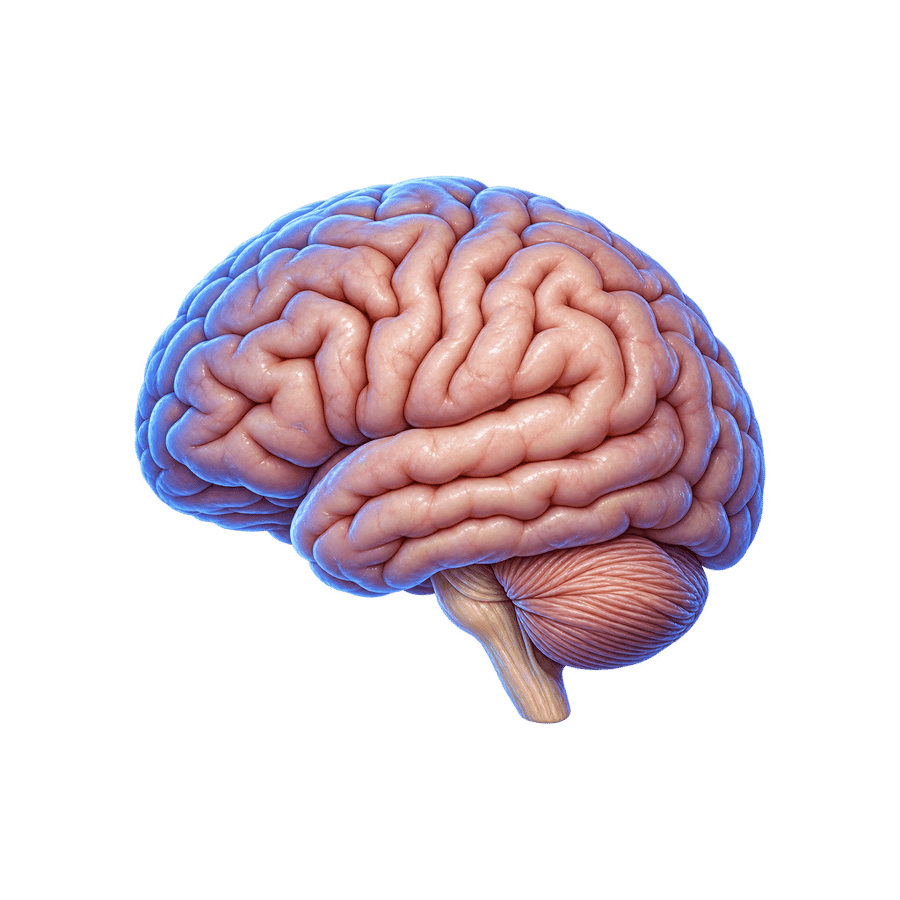
How it works, step by step
- Being awake makes adenosine. Busy brain cells burn ATP, their energy molecule, and adenosine is one of the pieces left over. In rats and cats, adenosine in the brain rose during waking, fell during sleep, and rose further when the animals were kept up late.
- Adenosine slows your brain down. It lands on receptors on nerve cells, like a key in a lock, and turns down their activity. You feel that as sleepiness, and it’s part of what pushes you into deep sleep at night.
- Caffeine is a key that fits but won’t turn. Its shape is close enough to adenosine’s to sit in the same locks, but it doesn’t switch them on. While it’s there, adenosine can’t land.
- The adenosine keeps coming. You’re still awake, so it keeps building up around the blocked receptors.
- Your liver clears the caffeine. About half is gone every 5 hours on average. Your liver turns 70 to 80% of it into paraxanthine, which blocks the same receptors too.
- The keys get back in. As the caffeine falls, the adenosine that piled up starts landing again. That’s the afternoon wall people blame on the coffee wearing off.
Caffeine also slows an enzyme inside cells (phosphodiesterase), which can raise adrenaline and other messengers. At the doses people actually drink, a 2022 review of the field says blocking adenosine is how caffeine acts.
Who worked this out?
The first careful test was paid for by Coca-Cola. The US government had taken the company to court for selling a drink with a harmful ingredient, and the ingredient was caffeine. For the 1911 trial in Chattanooga, Coca-Cola hired the psychologist Harry Hollingworth to find out what caffeine actually did to people.
Hollingworth ran 16 people through 40 full days in a laboratory, with caffeine or a dummy capsule, and nobody knew which they’d had. That was one of the first double-blind, placebo-controlled experiments in pharmacology. People varied a lot, but he concluded that doses over “6 grains”, about 390 mg, disturbed most people’s sleep. That’s close to the 400 mg dose that still cut deep sleep from 12 hours out in a 2025 trial. A history of the case found his results played little part in how the trial ended.
Why caffeine worked took another 70 years. In 1981 Solomon Snyder and four colleagues tested 10 caffeine-like compounds in mice. The more tightly each one stuck to adenosine receptors, the more it woke the mice up. Their conclusion was that caffeine’s stimulant effect comes from blocking adenosine.
Why does caffeine make me tired later?
The tiredness was there all along. A coffee at 8am keeps adenosine off its receptors through the morning, but you’re making adenosine the whole time. By early afternoon the caffeine has halved and the backlog starts landing. People take that as the coffee giving out, and reach for a second cup to tape it over again.
The second cup works, and it moves the bill to later. A cup at 3pm leaves about 35 mg in you at an 11pm bedtime, if it’s an 8 oz brewed coffee, and that 35 mg is still sitting in the receptors that would help you sleep deeply.
Where caffeine costs you at night
Adenosine is one of the things that sets how deeply you sleep. In both rats and people, caffeine weakened the brain wave signs of deep sleep after a night kept awake. Across 24 studies, caffeine took about 11 minutes off deep sleep, added 6 minutes of light sleep, and added only 9 minutes to falling asleep. What caffeine does to your night has the trials.
That’s why you can’t judge your coffee by how fast you drop off. The blocked receptors are still there after you fall asleep, and the deep sleep they would have driven gets shallower.
Do you get used to it?
You get used to some of it. When 20 young men who drink coffee every day took 150 mg three times a day for 10 days, their sleep structure 8 hours after the last dose looked the same as on placebo. One brain wave band was lower, which the researchers thought might be early withdrawal overnight. Scientists still argue about how much tolerance people build, and a big single dose still cost deep sleep 12 hours later in the 2025 trial. There’s more on whether you get used to it.
Why does it hit some people harder?
Two things vary from person to person. One is how fast your liver clears it, which the pill, pregnancy and smoking all move a long way (what makes yours faster or slower). The other is how your receptors respond, and a common variant in one adenosine receptor gene changes the sleep brain waves in some studies. In the 2025 trial, though, neither that gene nor the liver enzyme gene changed how the men slept.
7 sources
- Reichert CF, Deboer T, Landolt HP, Adenosine, caffeine, and sleep-wake regulation: state of the science and perspectives, Journal of Sleep Research, 2022doi.org
- Snyder SH, Katims JJ, Annau Z, Bruns RF, Daly JW, Adenosine receptors and behavioral actions of methylxanthines, Proceedings of the National Academy of Sciences, 1981doi.org
- Benjamin LT, Rogers AM, Rosenbaum A, Coca-Cola, caffeine, and mental deficiency: Harry Hollingworth and the Chattanooga trial of 1911, Journal of the History of the Behavioral Sciences, 1991pubmed.ncbi.nlm.nih.gov
- Antonio J and others, Common questions and misconceptions about caffeine supplementation: what does the scientific evidence really show?, Journal of the International Society of Sports Nutrition, 2024doi.org
- Gardiner C and others, The effect of caffeine on subsequent sleep: a systematic review and meta-analysis, Sleep Medicine Reviews, 2023doi.org
- Gardiner C and others, Dose and timing effects of caffeine on subsequent sleep: a randomized clinical crossover trial, Sleep, 2025doi.org
- Weibel J and others, The impact of daily caffeine intake on nighttime sleep in young adult men, Scientific Reports, 2021doi.org